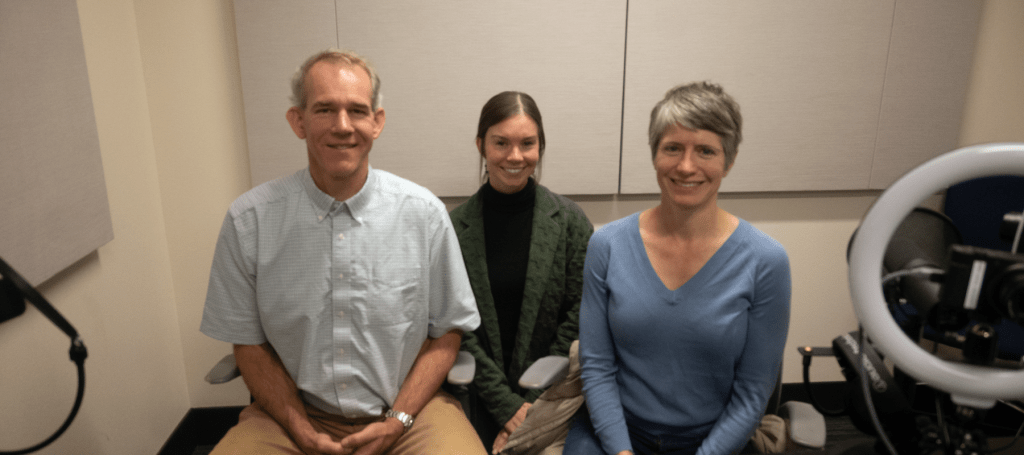
Welcome to the Discover Science Podcast, presented in partnership with the Discover Science Lecture Series through the University of Nevada Reno. In this episode, we’re diving into the rugged world of researchers who collect data in extreme environments. On November 19, 2024, I met with two professors from the UNR Department of Geography who are no strangers to this wild world: Dr. Julie Loisel and Dr. Baker Perry.
Dr. Julie Loisel is an associate professor who has studied carbon in peatlands from the Canadian arctic to the Peruvian tropics. Her expeditions have been funded by the National Science Foundation, the National Geographic Society, and Texas A&M University, to name a few.
Dr. Baker Perry is a professor of climatology and Nevada State Climatologist who has studied high-elevation weather in locations that include Mt. Everest and the Andes Mountains. His expeditions have been funded through collaborations including The National Geographic Society, the Government of Nepal, and Appalachian State University.
Listen to the full podcast below, or keep scrolling to view the full transcription and videos of the discussion!
Julie: We met this captain. He’s a friend of a friend. Paid him in cash. We. You know, there’s 15 of us, including a lot of students. So, like, the pressure is on. he needs to dump us essentially in this jungle that. I don’t know if anybody has ever walked there. There’s no path. And we’re going down on a canal on this boat, and we can’t dock anywhere. There’s no beach. Just imagine overhanging the densest vegetation you’ve ever seen. Like all over the canal. And we’re like, all right, well, let’s just stop here. And as we’re trying to get off the boat…
Ali: Welcome to the Discover Science Podcast, presented in partnership with the Discover Science Lecture series through the University of Nevada, Reno. I’m Ali Dickson, a graduate student at the UNR Reynolds School of Journalism. And your host today. In this episode, we’re diving into the rugged world of researchers who collect data in extreme environments. I recently sat down with two professors from the UNR Department of Geography who are no strangers to these wild worlds. Doctor Julie Loisel and Doctor Baker Perry. Doctor Julie Loisel is an associate professor who has studied carbon and peatlands from the Canadian Arctic to the Peruvian tropics. Her expeditions have been funded by the National Science Foundation, the National Geographic Society, and Texas A&M University, to name a few. Doctor Baker Perry is a professor of climatology and the Nevada State Climatologist, who has studied high-elevation weather in locations that include Mount Everest and the Andes Mountains. His expeditions have been funded through collaborations including the National Geographic Society, the Government of Nepal, and Appalachian State University. I’m excited to share the conversation. So without further ado, let’s get started.
Ali: Thank you so much for joining us today. You both have traveled to incredible places in the name of science. So to kick off this episode, I was hoping you would be able to share the wildest experience that you have had or encountered in the field.
Julie: Do you want to start?
Baker: I’ll let you go.
Julie: Okay.
Baker: Go ahead.
Julie: All right. Thank you so much, Ali, for having us. It’s great to be here. There’s so many studies and stories, and it’s hard to pick one. but let’s go with: Imagine this. This is the last day of a two week expedition in the tropics in Costa Rica along the Caribbean coast. We’re studying these palm swamp ecosystems, and we have to get there on a little boat. We met this captain. He’s a friend of a friend. Paid him in cash. We. You know, there’s 15 of us, including a lot of students. So, like, the pressure is on. He needs to dump us essentially in this jungle that I don’t know if anybody has ever walked there. There’s no path. And we’re going down on a canal on this boat, and we can’t dock anywhere. There’s no beach. Just imagine overhanging the densest vegetation you’ve ever seen. Like all over the canal. And we’re like, all right, well, let’s just stop here.
And as we’re trying to get off the boat and we’re, you know, losing ground and trying to, like, just even step onto the marsh. Our boat captain reminds us of the jaguars that are in the area. And at the same time, it starts pouring rain, and all the students are exhausted from this two-week trip. And we just decided to go ahead and go for this trek. And, you know, we marched like half-a-mile-in-an-hour kind of thing. And we have to machete our way through this jungle. and usually the fastest walkers are in the front. But the problem is, the slowest ones are also the ones that have to, like, step into the deeper and deepening mud. And so by the end of that trip, everybody was at least knee- if not hip-if not armpit-high in the mud, or I should say armpit-deep in the mud. and just laughing at about it all because we, you know, we’re like, so wet, so dirty. We’ve got some good samples, so I suppose that’s the good part.
And the other good part is the captain was waiting for us after hours of us being lost in the jungle, because there’s always that fear of, like, is this guy still going to be there? and he was. So that was one of those experiences that was pretty intense.
Ali: We love a happy ending afterward. It’s great. Did you see a jaguar?
Julie: No. Also a happy ending.
Baker: Well, thanks again for having us. It’s, really fun to, to be here with Julie and to share some of the stories from the field. For me, I was having a hard time deciding on one. So, I mean, let me give you two – that’s a-okay – First. The first that came to mind. We were funded by a National Science Foundation grant in 2016 to work on the highest, Andean summits. This is, up at 21,000ft to dig snow pits and sample for snow water equivalent and snow density, temperature, and also scout sites for potential future ice core, ice coring expeditions and bring back samples for isotope and chemical analysis from the snowpack. So one of the mountains we had chosen was Ancohuma, which is the third highest peak in Bolivia. And it’s actually pretty close to where I had grown up, as a kid, too. And so it’s a mountain that has always fascinated me.
It’s a pretty straightforward route to get up there, even though it’s high. And so we had a team of six that were going to climb this and all work together and dig a snow pit at the summit. And, and again, I mean, it’s high and there’s some, some challenging sections and places going up, you know, through an ice fall. But overall, it’s a relatively, you know, straightforward peak. So we thought we’d get up to, just over 20,000ft. And the normal route was not in, there had been a huge crevasse that opened up on the ridge, which meant that the only way to get to the summit was to go straight up the face, which was 70 to 80 degrees. And, we were with Anton. This is a joint colleague that Julie knows, and Anton gets to the base of that and realizes, you know, we talked through the options. They had the routes. Not in, and he says, okay, I’m stopping here. You know, there’s no technical climbing for me and the other team members, of, you know, a former grad student from the university with us too. We, they didn’t have the skills to go above that either.
And so I went on just with our two local guides and it was a very challenging climb, going up with water ice on the face because of the melting. but it was the descent that was the most difficult part because this is so high up. It’s just under 21,000ft. and, there was no sun on the face and we went up and it was super, super cold, but down climbing, we couldn’t repel it because it was a diagonal kind of traverse. And so down climbing this on water ice and very hard water ice was just incredibly taxing. And then the group that we had left behind didn’t continue to go. They were near hypothermic because it was below zero. Sun hadn’t risen yet, but I was able to get to the summit and dig, dig the snow pit and collect the samples and come back down. But it was just, that was one of the most challenging and difficult days that I’ve had in the mountains.
And then it may have been surpassed by our 2019 expedition, to, to Mount Everest, which was a two month expedition. And we spent, you know, a considerable amount of time in the death zone above 26,000ft. And I’ll tell some more stories from that in a bit. But those are the two that came to mind that were very challenging. Well, I’m glad you made it. I’m glad everyone made it. I’m glad you made it out of the jungle.
Ali: so it sounds like you’ve had incredible experiences. So bringing this into the research that you’re working on today, would you both, dive a little bit more into the research that you’re either currently conducting or have recently conducted in these extreme environments?
Julie: Sure. I’ll start. I think for me, you know, there’s a part of, adventure that drives my research inquiries. But, I guess the big research questions that I’m interested in have to do with a specific type of ecosystems that are called peatlands. So they’re wetlands that store huge amounts of carbon in their soil over thousands of years. And, if you look historically at where these studies have been performed, it was mostly in Canada, Alaska, and Europe. So northern places that are pretty flat. But and so that’s where I started, my training as well.
But eventually thinking about where else might peatlands be and what are the different locations potentially teaching us about a golden rule or, you know, like a broader understanding of those ecosystems could be coming from understanding these systems that might be under more extreme conditions. And so we went all the way down to Antarctica to find some of the plans. And we described some of the first peatlands from Antarctica, all the way into Patagonia. And so there’s a lot of, again, sometimes it’s the research questions that help guide where I go, but sometimes also where do I want to go? And maybe I’ll find some peat there. And that’s how, Baker and I went to Peru, because there’s some high-elevation peatlands in the mountains that I thought would be amazing to go study and see how old are they? Why is there a peat there? How thick are they? How much carbon do they contain? All of those questions. So again, it’s really a combination of really wanting to understand and document that ecosystem.
And the reason why it matters is because these peatlands, they’re about 3% of the land area but they contain about a third of all of the soil carbon on Earth. So think about a forest resource. It’s peatland soil for example. The soils would contain 5 or 6 times more carbon than like a jungle. So super dense, store of carbon they are kind of under threat by some of the ongoing environmental change and also land use change. So you’re losing three times the rate of peatlands compared to the rate of forest right now. And we’re trying to, essentially monitor them, assess where they are, understand them so that we can help protect them. And they could become carbon sources. So the carbon that was stored in the ground and it took thousands of years starts decaying and essentially being degraded by microbes and, farted into the atmosphere CO2 and methane and is contributing to ongoing climate change. So I just want to let them do their thing, those peatlands, and not destroy them. It helps, with land management and conservation.
Ali: That’s incredible. That information and research in Antarctica and Patagonia can help us here. It’s just a global issue and you bring it home. That’s wonderful. Thank you. Doctor Perry, you mentioned that you had some trips to Everest. So I’m sure, that’s something that’s ongoing, but could you as well, dive a little deeper into the research that you’re working on lately?
Baker: Yeah. So my current research focuses on understanding climate and climate change impacts in the highest mountains of the world, including on Mount Everest and also at the highest elevations of the Andes. And the major motivation for this is that these mountains serve as water towers. They store tremendous amounts of snow and ice that then melt, sometimes slowly, sometimes not, and sustain communities downstream. And so I think if there is a direct connection with, Nevada in the mountains that we have here, and of course, the critical role that that snowmelt plays in sustaining communities downstream. And so I’m excited to really develop that more in my time here.
But, you know, getting back to the big picture question there, over a billion people that live downstream from these, water towers in the Himalaya, Hindu Kush, Karakoram, what we call high mountain Asia, and then also in the Andes. And before we went to Everest in 2019, there was only one weather station above 19,000ft, even though that’s where the bulk of the snow and ice outside the polar regions is found, those higher elevations. And so there is this huge void of understanding of just basic climatological processes and also a big unknown as to how quickly, key parameters such as precipitation, such as temperature, such as relative humidity, cloud cover were changing up in the highest elevations. And so my work over the past decade, both in the Andes and in the Himalayan Mount Everest has been trying to fill that void and bring back the critical data that we need to understand what’s happening at the highest elevations, just to improve basic scientific understanding, but also to improve the glaciohydrological models that are used to make projections of future water resource availability in these locations.
And so, yeah, a lot of my role has been focused primarily on the installation and the maintenance and operation of the weather station networks that we that our teams have installed in also just the analysis of the data that, that have come back from the and so that has presented just a huge set of challenges, but also lots of opportunities to get a glimpse into the, the roof of the world. I mean, falling into Everest in 2019, we knew more about the weather, on the surface of Mars than we did at the highest elevations and in the Himalaya or on Mount Everest. So we’ve we’ve definitely, learned a lot and have made some strides. But there are many other mountain regions around the world that have huge data voids. And there are many places here in our own state of Nevada that have some big data gaps. In fact, we have the lowest density of precipitation gauges of any state in the country, here in Nevada, and huge gaps on our higher mountains. And so that’s a big priority for me moving forward, is to expand our observational networks and enhance some of the existing instrumentation.
Ali: So I won’t use the word lifetime again, but this sounds like an incredible process of research. So how did you get interested in these high alpine weather data conducting sort of expeditions?
Baker: Yes, That goes back to my childhood. I spent some very formative years living in New England, in the state of Maine, and had some very severe winters there that getting captivated me with cold and snow and extreme environments. I followed the weather very closely from the summit of Mount Washington, which is one of the most extreme environments on the planet that’s actually instrumented. And then when I was seven, our family moved to,13,000ft in Bolivia. And I’ve lived there for two and a half years. I went to school there. We took family outings up to over 17,000ft. And I gained this tremendous fascination and also an appreciation for the role of mountains as water towers and sustaining communities downstream, and also, of course, the just rich cultural, landscape of the region and the very significant indigenous cultures and traditions that were there. So to that, I mean, that laid the foundation for me.
And then I think, as I return back to our family’s roots in North Carolina, I just I mean, any time snow was in the forecast, I was camping out in my front yard. People, my family and my friends that I was a little strange and just very interested in weather. And then as I went through graduate school and, in my formal academic studies, I was able to find a way to combine these different interests with mountains and the highest elevations. And so that’s, that’s kind of the pathway I took a little bit circuitous, but, but the childhood experiences were incredibly formative. Yeah.
Ali: Maybe the word lifetime is relevant here. But that’s wonderful that you have like that home tie to it more than anything. Great. Thank you.
Ali: so you both have done wonderful research in wonderful places over decades. And I’m sure you have a lot of highs, but what are some of the hardships, like the difficulties in finding crews and researchers that have this experience, from like recruiting to actually making sure people are capable to go into the field in, like, fulfill this, this expedition, the results that you need to to find.
Julie: I think we could talk all day about this because, and that’s a question we often get like, well, what about safety? And, you know, we really put as many guardrails as possible when we’re in the field. And, you know, I’ll give you a couple examples. So any crew that I take into the wild, are required to take a 16-hour wilderness first aid class, which by no means is going to transform anybody into a doctor, but I think it teaches them enough that now they become aware of the danger more than anything else. So that’s one thing that we do. We obviously always stick together. we really work hard on having a positive attitude, because what you learn in being far away is that it’s going to be hard. You know, we’re telling these stories and, but it’s all in hindsight when you’re living it and you’re stuck in the mud up to your armpits for hours, it’s no fun. And if you start complaining about it and whining, it makes everybody in a worse place. And so there is a lot of just kind of learning through these experiences and how to turn them into something. I don’t want to say positive because that’s impossible. Most, you know, just turning the experience into, a communal experience, I think, like you have to fend for yourself and almost in a survival way, sometimes in the Amazon where you feel like you’re part of the food chain. But also you become very aware of everybody else around you and how you might want to help them or how they might need you. And there’s no words exchanged after.
Often times you just know, like there’s an instinct almost to be in nature, but also be in with people in nature. And I’m I know I’m only partly answering your question, but I think to me that’s what comes to mind the most is like, how do you make up of any situation and how do you make it work through? And yeah, the students are not prepared. Most of them. They’re absolutely not prepared for that. And they tell me, you know, like, yeah, if I knew this was the trip that I signed up for, maybe I wouldn’t have come. But you know what? I’m so happy that I’m here. Because, you know, I’ve overcome all my fears. All. You know, I’ve pushed so many new limits, and. Yeah, so, I mean, I think for me, I opened the door and, I keep them alive because then they need to come, you know, make their, like, do their part and, meet me there. Yeah.
Ali: Do you have a this is a little less extreme, but do you have in-class or, you know, pre-expedition bonding sessions is to create that, that sense of community before you go out into a place where you kind of really need to rely on each other?
Julie: It depends. Sometimes we do, sometimes we do a little camping trip or even just like a couple like the 16-hour wilderness. And usually we try to do it as a group. And so we meet there and I organize lunches and places and, you know, I bring my gear and I say, this is what I bring with me. And I make them, you know, feel it, touch it. That’s all the questions we get, you know, and also when we go into the field, it’s not day one where thrown in the field. So there’s many days of acclimation, whether for high elevation or just for the tropical overwhelming humidity or, you know, so we do, smaller hikes and, shorter activities so that we all get to know each other and, yeah. So that’s how we do it.
Ali: Awesome. Yeah. I’m sure that acclimation period is necessary for for knowing each other and also just knowing yourself.
Julie: Exactly. Yeah. So I like to say, to my students that, you know, the field is to me an intellectual seedbed, but it’s also a personal incubator. So, you know, like, you will learn a lot about yourself, emotionally, physically when you’re in the field because you’re separated from all the comfort that you’re already or usually used to, and you really kind of have to rely on your instincts and also the others with you and build a trust that maybe you’ve never had with other people before. Yeah, yeah.
Ali: What a gift, if all goes well.
Julie: I think it’s amazing. But yeah, of course there’s always the possibility. I think some go as well as you hope.
Ali (to Baker): Similarly, do you have any, any words of wisdom or difficulties? Is this something that you’d like to share on just how to gather a crew that can climb Everest?
Baker: Well, I think just, circling back to something Julie said about how important just, a positive kind of attitude and just, infectious enthusiasm can be with groups and teams. It’s just there’s going to be challenges and especially the places where we work, it’s going to be cold. It’s going to be at altitude. It just magnifies those challenges because it’s hard to sleep. It’s just you’re not feeling well and it’s it’s remote. It’s connectivity is a challenge. So having teams and team members that, that are willing to work together and just maintain a certain degree of positivity under the most challenging of circumstances goes so far. And that’s a big quality I look for in team members and certainly for the places that I work. Fitness and just previous field experience is so important. And if we’re working on glaciers or going up high, you’ve got to have the technical experience with crampons an Ice ax, mountaineering, and that familiarity and safety component as well.
But yeah, the challenges are just there. There are so many. And you know, we can’t get weather stations up to some of the places where we all work. It’s all human power. I mean, helicopters only fly up to about 21,000ft so they can help in some cases up to a certain point. There are no helicopters that routinely operate in the Andes of Peru and Bolivia at those places. And so that’s been all human power. But, you know, these places are remote, too. And so expeditions are long. It takes a long time to get there. And that translates into just a lot of time away from the office and from family. And that takes a toll. I think, I mean, there’s incredible data that we bring back, but from an efficiency standpoint, I think we could be a lot more productive in that sense by using existing data sets and publishing papers from that.
But there’s something so valuable about going to the field and learning, as Julie was talking about. You see things just completely differently. And for students to have those experiences, it’s just, you can’t even compare it with a classroom, traditional classroom environment when they’re out there feeling the effects of altitude, seeing glaciers and glacier change up close, bringing back, you know, a peat core, you know. It’s stuff that you just can’t replicate in the classroom with the students.
I mean, I’ve been taking students to the Andes since 2000, and they are life-changing experiences where people are really transformed. I mean, it’s not easy, and they’re frequently pushed to their breaking point, but from an educational perspective, it’s just eye-opening and just a personal growth perspective, too. It’s so transformative. And so, yeah, those are just a few, I guess comments, and observations I would make on that.
Julie: I’ll add to this. I remember the trip and the Andes we did together. And we had 15 students from his university and 15 from mine. And we had, of course, the, you know, the families who live there who helped us carry our gear and so much more. And you know, some students, yeah, they were there for eight full days, trekking. There’s no bathroom, you know, no electricity. It’s 10 Fahrenheit every night and, you know, 60 during the day. And we’re hiking all day long. No internet, of course, none of that. And I thought these kids were born with the internet at their fingertips. And it was amazing to see how they got close together. And at the end, they didn’t want to sleep in their own tents. We all slept in the big classroom tent because they just loved to be together so much.
But what I wanted to say is that the coping mechanisms for different students was different. Some of them… I remember one of my students, she, you know, like, you know, imagine this. You know, we’re 17,000ft gain. No bathroom, right? It’s like just so, so rugged. She would put on her full-on makeup every morning because, I think for here, it was like, this is me, you know? Like this is how I like to be, and she was just preparing for her day. And that was probably her own personal time that she had to do her thing.
And some people would go to, you know, sit down by a rock, look at the landscape, or maybe bring their own music with them and, you know, tiny solar panels we had. It was just so that we could have a little bit of energy so they could listen to their own music, to just, yeah, to cope, to be okay with the moments that were harder. And so those are often the stories we don’t talk about.
And we also have our own, which, you know, yeah, I struggle many times in those trips. Nobody knows, but it’s hard. It’s hard to be far. It’s hard to be isolated. It’s hard to take care of everybody and make sure everybody’s on, you know? Yeah. There’s so many hard things about those trips, and then making sure the science gets done, of course.
And that to me, it’s like, how do you teach the instinct to explore and discover to other people? You know, that’s kind of my secret mission in those trips. And it’s really hard to do. And you can’t say, go sit there and read a poem, you know, like if you force it it obviously won’t work. So how do you want people to keep doing what you do, and how do they find their own way in nature?
And, you know, I don’t know about comfortable, but, you know, feel like they belong there and they love it and want more. And some of them, they get it like right away and others, it’s just a whole journey. So I just wanted to add that.
Baker: Yeah, I mean, there certainly have been students that, I mean – I have one that comes to mind who, you know, just was totally into snow and bragged about how he, you know, slept with his windows open back in Boone in the winter and just loved the cold. Well, we took him to 16,000ft and he’s in that environment the whole time. And he, you know, it hit him hard, right? This is very different than what I had imagined. And it was a challenge. I mean, he made it through the trip, but for some people, there is a realization like, okay, I’m glad I did that, but I don’t think I want to do that again. But it still helps them push these personal boundaries about you know, what they’re capable of and gives them this appreciation for the people that live there, especially to work in these places day in, day out.
I mean, we so Julie and I both worked at, on the land of one of the highest permanent inhabitants in the world on . That was at 16,700ft. It has a thousand alpaca up there and, I mean, just the hardships of just the climate and altitude that he goes through are just phenomenal. And, you know, we were there for just a few days to speak up, and students are totally pushing their limits. So it definitely, these experiences certainly opened their, expanded their horizons to what life is like in these places as well.
Ali: On that note, you’ve touched about just different interests and ways to ground yourself. How do you handle the diversity in your crews whether it’s, you know, race, gender, ethnicity, just culture if they’re from other countries even just interacting with, you know, folks that you’re not familiar with within that country? Like, how do you make sure everyone gets the job done that they came to get done but grows as much as they can grow as a person?
Julie: I think we find more in common that not. That’s different in those moments because they’re so intense that, like we were saying earlier, you know… everybody wants the best for everybody you know? So I think we kind of look, we don’t look at our differences so much. We look at what unites us in that moment. And so there, you know, are suppose, some compromises that individuals need to make, that it’s not going to be all the comforts you’re used to or the conditions that you would want to, but you need to adapt to what the situation demands. Yeah. So that’s what I’ll say, I think, yeah.
Ali: That’s beautiful, that we’re all more similar than different when it gets down to it.
Baker: And I would just add to that, that I mean the diversity of teams is so important in our most successful expeditions and most, you know, I think most enriching I would say have had substantial female leadership in them. This has been from former graduate students. We’ve had the Bolivian Cholitas Escladoras; these are Aymara women climbers that I’ve worked with in Bolivia that join one of our expeditions in Peru with National Geographic. They climb in their traditional attire. This includes Dawa Yangzum Sherpa, who is the first internationally certified high-mountain guide, female high-mountain guide about all of Asia, was part of our teams in 2019, 2022, and 2023, in Everest. In my experience, has enriched so much of the team and contributed to our successes.
And then, of course, there’s the diversity of culture. I mean, all of our teams are international. I mean, not just like U.S. in Peru or Nepal, but I’ve got, you know, colleagues that join from the U.K. We have, you know, team members from across Latin America on the expeditions. And then, of course, there’s the local sherpa or the indigenous Aymara Quechua that we work with that are intimately familiar with those areas.
And so we don’t always, I mean, language can be a barrier at times. And that’s where I think, for me, spending as much time as I have in Bolivia and Peru, you know, I do speak Spanish fluently and then speak some of the Aymara indigenous language as well. You know, a little bit of Quechua.
But just one example I’ll share, you know, there’s a, you know, graupel is a type of snowflake that we get commonly in the mountains.
Ali: Could you explain what a graupel is?
Baker: Yeah. Graupel is just a snowflake completely encased in rime ice in supercooled liquid water that freezes on the pellet. Well, it turns out it’s very common in Peru, in Bolivia, in the Himalaya. But the Quechua language even has its own word for this. It’s called pati. And so whenever, you know, this happens frequently in around the field, it’ll start graupeling. And there’s this kind of shared fascination and appreciation for it. And we all kind of look at one another and start smiling and saying pati, pati, pati. You know, that’s the name for graupel because the teams there know that’s really my favorite precipitation type.
And so that’s kind of an interesting cross-cultural bridge that comes in there as well. But the diverse teams are so, so important in just, I mean, making sure people come back safely, making sure we meet the objectives of the expeditions and, in all of those aspects is really those are all critical.
Julie: I’ll add to this because that’s something students ask a lot. Because you mentioned women in those field expeditions, you know, they ask me if, you know, I approach things differently. And I never make a big point that, you know, it’s this trip led by a female or something like that. But also I think that there is a perspective that fieldwork is kind of macho, you know, like you have to climb to 20,000ft and carry these heavy packs and do all these really, like, labor-intensive physical things.
And, I mean, part of this is true, of course; I don’t want to belittle the intensive physical aspect of the work. But I think that seeing a female leader in those expeditions opens the doors and the minds to many people that would not come otherwise, because they would think, “Oh, it’s a bunch of boys that are going to try to race to the top right and roll rocks down the hill,” because we know they do that. But yeah, right. So I think that in having females on the team and leading teams makes the whole endeavor more approachable, not just for women.
I think just for a lot of underrepresented people in general who will be like, “Oh yeah, well, she’ll probably understand this,” or, “Or what if I have my period?” Right. So all these things, that suddenly those walls are gone and it helps.
Ali: Sort of on that thread, I know that there’s been an increase of folks just in general getting interested in outdoor recreation and things like that. Are you seeing that in relation to students being interested in pursuing outdoor science research, or is it harder to recruit folks for these expeditions?
Julie: That’s a tough one. I think, to me, you know, I got into this science because I love the outdoors. And when I see things, I want to understand them. And they kind of, my wanting to explore and my wanting to know feed each other, but I think I can totally understand some people just wanting to go on the outside, on the outdoors to stop thinking, and yeah. So I don’t know if there’s a good recruiting tool to do science.
Baker: Yeah, I mean, that’s a good question. I think, I mean, Julie and I are both new here at UNR, and so, I think, we’re… I think it’s an open question. I think we’re optimistic. At least I can speak for myself. Optimistic that I mean, given it seems like a pretty outdoor-focused community here in Reno, at UNR, and of course the mountains are right here. I think that will translate into a lot of interest in field work. But I don’t know yet.
And I think, you know, the advice I would give to prospective students is to take some classes with us. and we’re also trying to set up some international field experiences. And those are always great opportunities to get, for students in particular, to learn a bit more and test some of those boundaries and spend time out in the field. And that’s, I think, a very effective way to deciding whether that’s something that maybe an undergraduate wants to do for graduate school and beyond. So come to the field.
And, I think, you know, it’s been tricky because the pandemic, of course, changed. Gosh, I mean, we didn’t do any field work to speak of for a period of time there. And that has impacted, of course, the high school experience and college experience for other students. So I think we’re still coming out of that. But optimistic that, yeah, I think that there’s going to be interest.
Ali: And so then I will round out this podcast with one more question. And that is: if someone’s interested in become a member of your crew or a researcher or an interested student or just someone who is very science-curious and wants to learn more about the wonderful work that you both are doing, where can they go to find more information?
Julie: Yeah, find us on the geography department website and email us. Stop by our offices, all of the above. Yeah, you’re welcome to do that. We want to chat with you, get to know you, hopefully convince you to come in the field with us. We recruit undergrads, grads, postdocs, colleagues, just locals. We want to chat on all of that.
Baker: Yeah, absolutely. I mean, I’d say the same. Don’t hesitate to rech out. I’m always happy to talk to folks. Come by, chat in the office, or meet up somewhere and tell you about opportunities that may be coming up.
And yeah, that reminds me, I mean, I’ve had faculty colleagues join us on these expeditions who didn’t really even have a research interest. They just wanted to go. And so there are opportunities to, even if you’re not a student but connected to UNR, to potentially come in the field in some capacity with us as well.
Julie: Same, and even teachers too, if teachers would like to see that and develop activities for their classrooms, high school or middle school or any level, that’s always cool to have.
Awesome. Cool, well thank you both for being here, so much, today. Thanks for what you’re bringing to UNR and to just the world as a whole, going to these extreme places and bringing back some data for the greater good.
Baker: Well, thank you. This was a lot of fun.
Julie: Yeah, thanks, ali. This was great.
Ali: A huge thank you goes to Dr. Loisel and Dr. Perry for sharing their stories and experiences, and a big thank you goes to our listeners today for joining us today as we continue to discover science.
 ali dickson